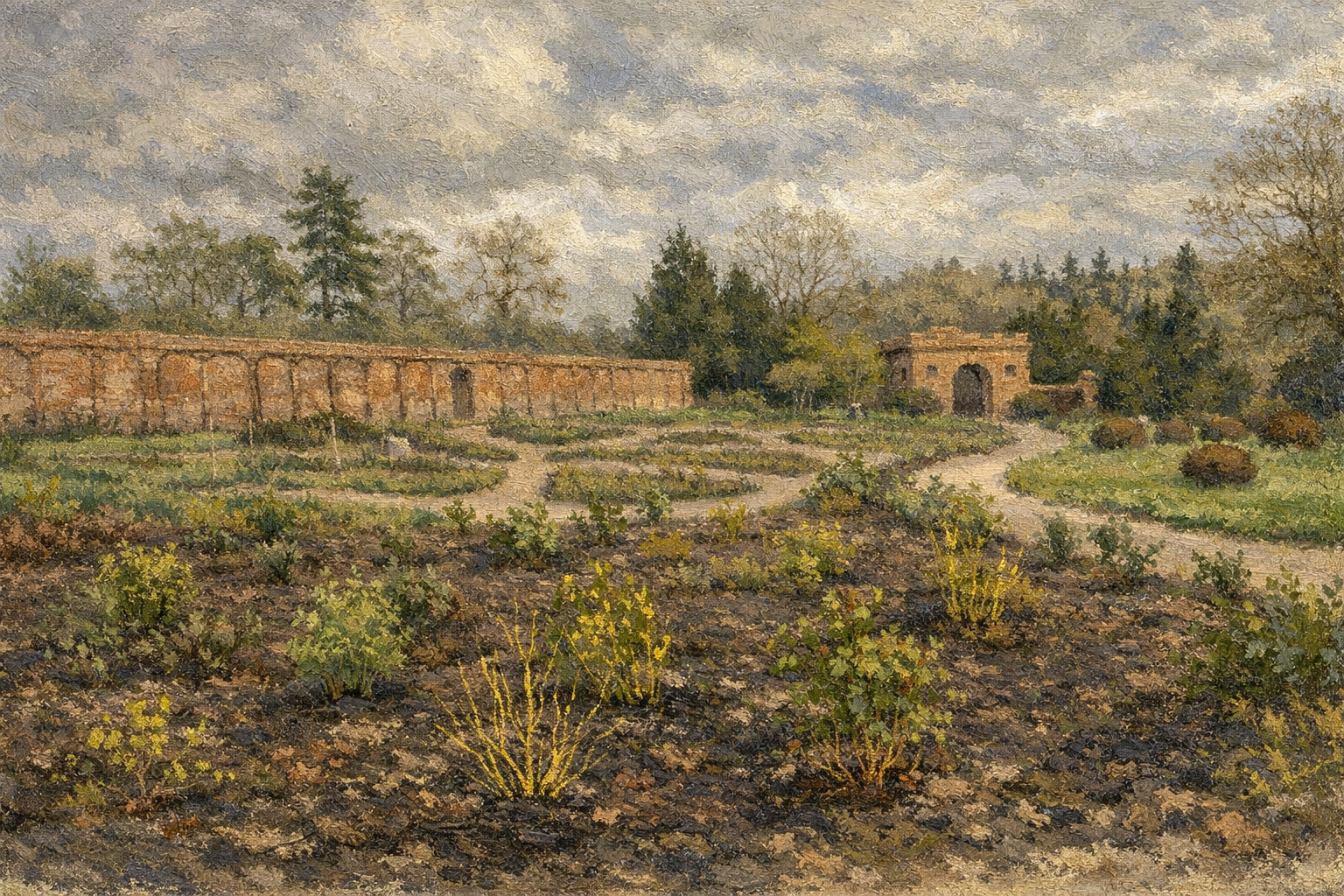
As I look out of the window on this dreary January day, the garden stares back at me with the tired expression of a season that’s outstayed its welcome. It’s been a wet and miserable winter compared to last year, when the ground was dry enough to plan from as early as November. This year, the wind has driven the task of sweeping autumnal leaves well into this month; the ceaseless rainfall has all but killed our lawn and replaced the grass with moss. Everything looks a little beaten and neglected.
We can look at our own first drafts with that same sense of overwhelm, particularly when a busy season of life has left the manuscript looking unattended. The weeds were always there, of course – they’ve only grown and are now more obvious: plot holes, inconsistencies, the nagging feeling that the prose isn’t quite right. But amidst the chaos, one truth remains as constant as the seasons themselves, and it should be printed in capitals above every author’s desk:
GET THE FIRST DRAFT DONE
It sounds simple. And it is. The difficulty lies in letting it be so.
The Marker In The Mud
Winter often means messy work. There isn’t a real rhythm to the garden in these early months – it’s often stop and start, wet and windy, with rare days of calm that allow for any progress. The garden has a framework, but much looks bare. It can be difficult to imagine what the final result will look like. Yet when we do get out, we’re not planting perennials, nor cutting back blooms. Instead, we have our wellies on, and our feet firmly in the mud – to weed the beds, to turn the soil, to spread manure, all in preparation for the year ahead.
When spring is a dream beyond these overcast skies, we keep ourselves busy by planning. The other day, I pressed a simple marker into the mud. It read only: ‘climbing rose’.
I don’t know which variety it’ll be, how tall it’ll grow, how much we’ll need to train it, or the colour of its bloom. All I know is that space has been reserved. The vision is held. In the meantime, my wife and I can tend to the rest of the garden without worry, knowing we will return to that marker when the time is right. We will question it. We will talk about it. Perhaps we’ll even change it. But for now, we’ve made a start – and in the garden, as in all things, a start is all that’s needed.
“The biggest obstacle to good gardening is the desire to know the answers and not the questions.”
– Monty Don, An Interview From The Telegraph
TK – To Come
As with the garden, so it is with the first draft. The equivalent of a marker in the mud? A simple journalist’s device called TK – from the old typesetter’s shorthand tuk kum, meaning “To Come”.
To keep the flow of the first draft, you need only press a marker into the manuscript: “TK - description of house". Your mind stays with your character’s actions, with the tension of the scene, with the momentum of the story. If the rose can wait, the flowery description can as well. What matters is the momentum – the forward motion that carries you from one scene into the next.
Why “TK” over “TC”? Because the letters “TK” rarely appear together in the English language, making them as conspicuous in a manuscript as a wooden stake in an empty flower bed. When you return to edit, a simple search for “TK” reveals every marker you planted – every decision you deferred, every space you reserved.
Of course, “TK” is merely one gardener’s preference. Some writers use square brackets – [describe the castle] – or highlight passages in bold. The method matters far less than the principle: that you have a system, a shorthand between your present self and your future editor, that allows you to stay in the flow of the season you are in. Winter is not the time to arrange cut flowers. It is the time to plan, to dig, and to plant your markers in the mud.
“Gardening is inevitably a process of constant, remorseless change. It is the constancy of that process that is so comforting, not any fixed moment.”
– Monty Don, A Kiss On The Nose, The Guardian
The Season of Revision
Before you know it, spring has arrived. You can see the buds swelling on the branches, and the first blooms of the bulbs peeking through the ground. The garden is alive, and the time to tend to it has come. The seeds you sowed in trays in the dismal days of wind and rain are now pushing through the soil beneath a blue sunlit sky, and you need to begin thinking about summer – about the final picture. Because some of what you’ve planted may not be working as you intended; other parts may have become overgrown and unruly, dominating other, lesser plants that need their time to bloom under the sun.
In Britain, this reckoning often comes in May after the final frosts have passed – a sudden mad rush to clear away the detritus of spring and plant out the show-stoppers you’ve been carefully nurturing under glass.
And as it always does, the season turns. The time of revision is at hand. The clippers come out. The spent growth of the spring bulbs is cut back, and the perennials swell into full, generous bloom. The garden begins to reveal its true shape – not the one you imagined in January, nor the half image you had in May, but the one that grew from every decision you made and every marker you planted along the way.
You return to that stake in the mud. Perhaps now is the time to find the climbing rose that belongs in your garden. Or perhaps you replace it with something altogether different – a clematis, a jasmine – something you couldn’t have imagined until you saw the garden in bloom. Or perhaps, looking at how beautifully the surrounding plants have filled the space, you find you don’t need anything at all.
The garden will flourish. And so, with patience and a little faith in the seasons, will the story.